RES MUSICA: Musica Classique et Danse, 2025
FINAL CONCERT of the 9th Vilnius Piano Festival
Philharmonic Concert Hall, Vilnius, Lithuania
World Premiere of Stefan Lano Piano Concerto Nr. 2
RES MUSICA: Musica Classique et Danse, Paris, FRANCE
December 4, 2025
by Stéphane Friédérich
The November 29 concert at the Vilnius Philharmonic closed the ninth edition of the Piano Music Festival founded by pianist Muza Rubackyté. An ambitious event performed in a mythical concert hall of Lithuanian musical life since 1902.
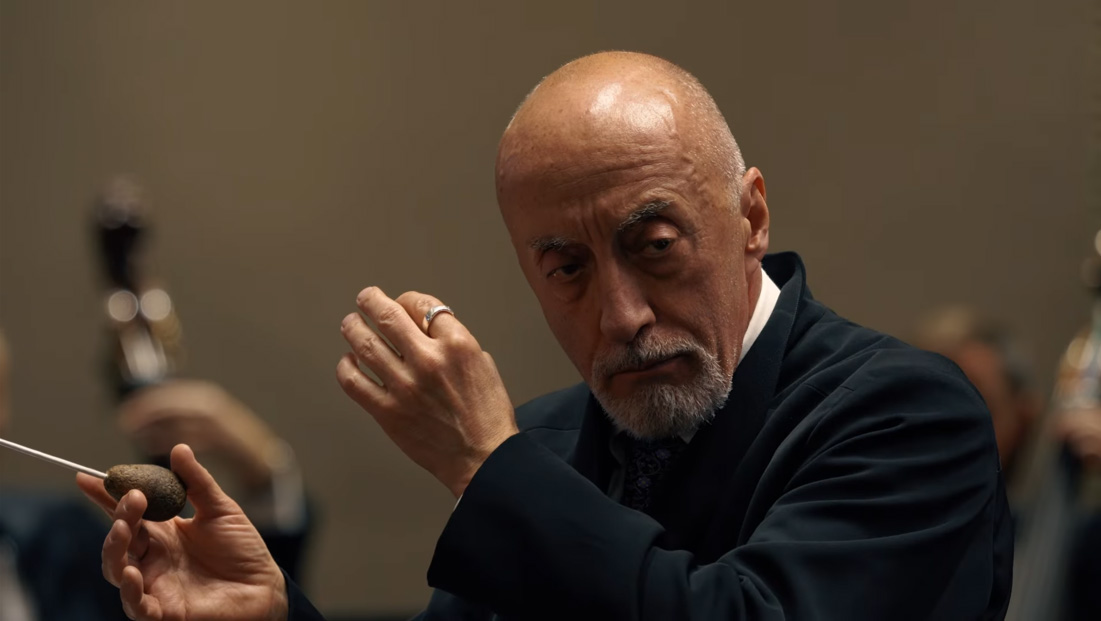
STEFAN LANO conducts the concert in the Vilnius Philharmonic Hall, with Muza Rubackyté as soloist in a program as demanding as it is particularly well-constructed. Demanding, because the music-loving public hears works rarely programmed in a concert that culminates with the world premiere of a piano concerto composed by the conductor and dedicated to the soloist. Well-constructed, because the works progress in complexity while unified by the harmonic links which render the evening a sense of harmonic progression ranging from Viennese post-romanticism to the expanded tonal language of the concerto.
The concert began with Erich Wolfgang Korngold's Straussiana. The spirit of Strauss family (Johann Strauss I. and II.) revisited with elegance, without the Hollywood pathos too often associated with the music of Korngold's time in the United States, skilfully elides to the second work of the evening, Franz Schreker's Valse lente. Stefan Lano allows the homogeneous interconnections to breathe while highlighting the clarity of the woodwinds creating a chamber music atmosphere with delicately chiselled harmonies and textures.
With the Symphonic Fantasy of Richard Strauss' Die Frau ohne Schatten, the orchestra now fills the stage. Lano coordinates the fluidity and textural density with an assured elegance with discreet modulation of tempi while balancing textures with precision, attentive above all to the colours and solo passage with remarkable accuracy and finesse.
It is only after the concert that we learn the remarkable story of Stefan Lano's Piano Concerto whose world premiere we have heard. Some twenty years ago, Muza Rubackyté discovered that this conductor with whom she had so often worked, was also a composer of merit. Following the premiere of this Symphony N°3 in Vilnius in 2004, a piano concerto was immediately commissioned. With three quarters of the hand-written manuscript completed, Lano was the victim of the theft of his belongings by a fake taxi in Buenos Aires. Although the Teatro Colón and Radio Nacional Argentina made every effort to have the manuscript returned, the score was lost forever. It was during the period of the Covid pandemic that he completely re-composed the work retaining only one important theme from the original version, now published by Ries & Erler Berlin.
The works of Stefan Lano with which we familiar and, given his compositions studies with Richard Hoffmann and Isang Yun, suggest that the concerto will be part of a filiation close to Schönberg's Second Viennese School. It is decidedly not. Rather, the work is designed in three classically-constructed movements, the first two of which are interconnected. The opening Moderato in C-sharp minor over an ominous pedal-tone is cinematic in its depiction of a field of battle after the battle. After the solo piano entrance as a cri de coeur decrying the primitive banality of all military conflicts, the piano integrates with the orchestra not merely as a solo instrument, but also as a section of its own within the ensemble wherein the work often resembles a piano symphony. Muza Rubackyté referred to the "extraordinary complexity of Lano's harmonic syntax in how he writes for the piano with chords of the ninth- and tenth in passages of dramatic velocity and passion in which the piano seems to seek peace within our increasingly bellicose world as personified by the orchestral environment of the first movement.
In the haunting Larghetto, the lyrical capacity of Rubackyté's pianism comes into full focus, the first subject of which outlines her name in its melodic contours which develops into interplays of atmospheric soundscapes and lyrical dialogues interspersed between sections of the orchestra and the piano solo, the highlights of which are the cantabile interventions of the solo trumpet. Lano's harmonic syntax can best be defined as polytonal or, as Alban Berg would have said, "pan-tonal" in that, while atonal elements exist in the work, the listener never feels harmonically abandoned as often happens in new works which eschew a sense of harmonic tension and release. The soloist asserts a liberating independence in a stunning cadenza of post-romantic melancholy which, with the re-entrance of the orchestra brings forth one of the most hauntingly beautiful moments of the evening. While Lano's musical roots are imbedded in the Second Viennese School, one still senses his prediliction for coherent and expressive harmonic progressions.
The Finale (Allegro giusto) is at first reminiscent of Bartok's Concerto for Orchestra or any of his or Prokofiev's piano concerto. With Lano's lush orchestration, the Finale gradually increases in tension, superimposing sheaths of previously heard "Leitmotivs" of which the Dies Irae comes increasingly to the fore. The movement is swept along in an orgiastic manner bringing to mind Edgar Allen Poe's Mask of the Red Death. The drama and power of this movement is so appreciated by the public that an encore of the Finale becomes obligatory.
The National Philharmonic Orchestra of Lithuania impresses with its level of technical expertise and a symphonic power which can hold its own with any of the great European orchestras. One might justifiably hope for a tour to France to highlight the talent of this first-rate ensemble.
In the end, the enthusiastic public signals a triumph for the composer and interpreters with an extended standing ovation culminating a truly stunning concert.